
POK's educational podcasts
METID created the space Spreaker dedicated to educational podcasts, keeping the name POK - Polimi Open Knowledge to emphasise its continuity with the MOOC platform. This space brings together audio content designed for training, often closely linked to online courses thanks to the video-podcast format. Some of our courses are available either as complete MOOCs - with supplementary materials such as PDFs, infographics, quizzes and activities - or in audio-only format, for a more flexible and accessible experience. Thanks to Spreaker, podcasts are also distributed on major platforms: Spotify, Amazon Music/Audible, Castbox, Deezer, Podcast Addict, Podchaser and iHeartRadio.
The role of METID
We believe that the podcast can be a powerful ally in broadening and diversifying teaching methods, offering new ways of disseminating knowledge and enhancing the voice of teachers.
That is why we support teachers in the design, realisation and recording of their podcasts, accompanying them at all stages of the process: from thedesign of content and narrative structure, through to technical production and publication.
In this way, we contribute to create more engaging, accessible and sustainable learning experiences that integrate the sound dimension as an important part of innovative teaching at the Politecnico di Milano.
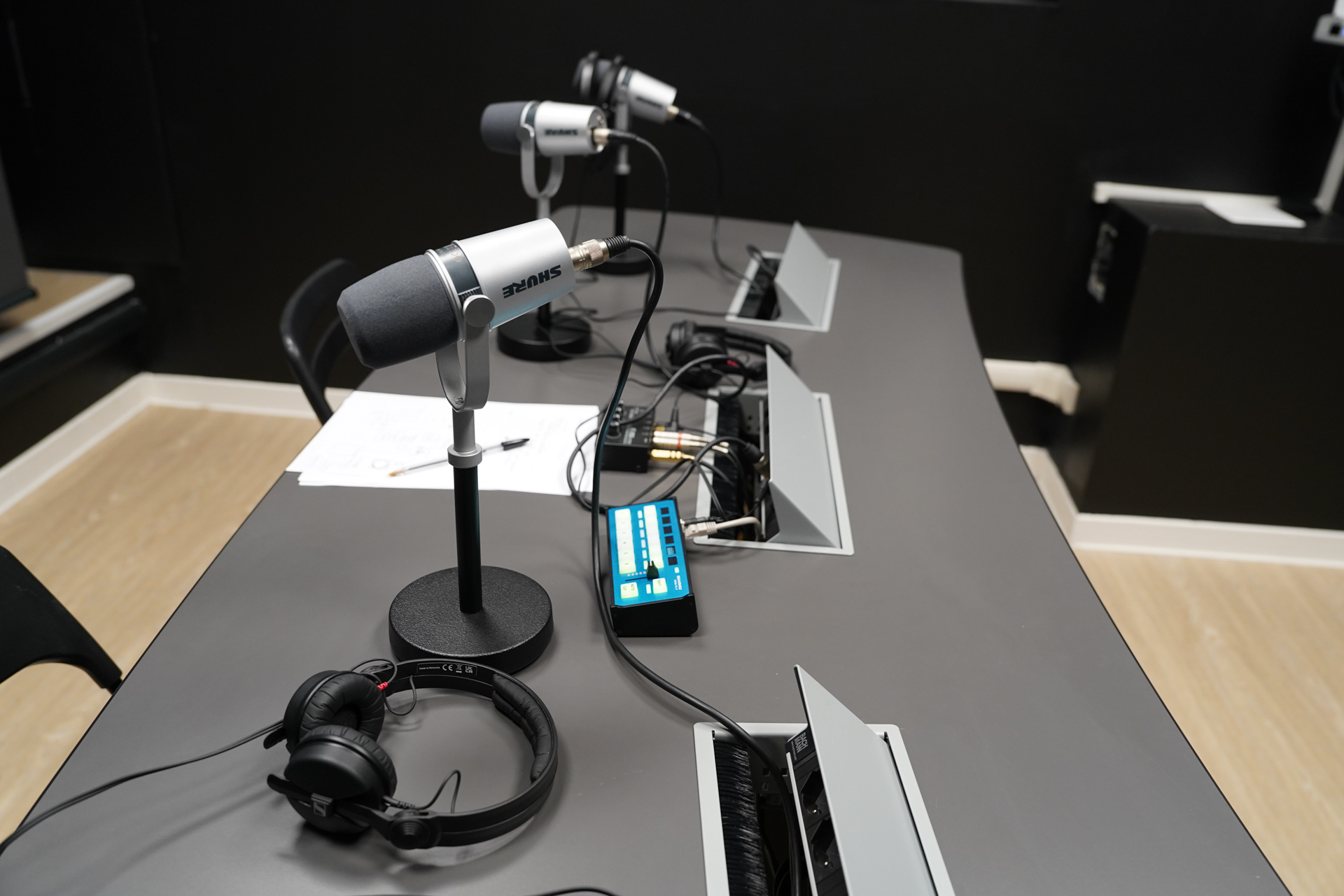
To support this process, METID provides a dedicated recording room for podcasts, equipped to guarantee a high audio quality and professional production experience.
Podcasts and teaching
Podcasts in education
The podcast is assuming an increasingly prominent role in the contemporary learning experience, thanks to its ability to combine accessibility, flexibility and narrative involvement. In an ever-changing educational landscape, it represents a tool capable of enriching teaching, making learning closer to the needs and rhythms of each student.
Flexible and accessible learning
The audio format allows students to learning anywhere, anytime, even during everyday activities such as travelling or breaks. This makes the podcast a ideal medium for continuous training, particularly for those who have fragmented study time or wish to learn independently.
Moreover, it is an inclusive tool, which allows people with visual difficulties or reading concentration problems to access content in an immediate and engaging way.